Inspector Raglan
The Murder of Roger AckroydInspector Raglan is the Cranchester detective whose forceful early theory makes Ralph Paton the central suspect in Roger Ackroyd’s murder. His investigations give the case a police timetable and a chain of circumstantial clues, but the narrative repeatedly shows the distance between a confident reconstruction and a proven conclusion: Poirot challenges the assumptions behind Raglan’s theory, and Raglan must revise his view as new evidence emerges.
Identity and Arrival
Raglan enters the investigation as an outsider from Cranchester, brought into a village where local information travels through gossip and where Inspector Davis has already been working. Flora Ackroyd tells Dr. James Sheppard that Raglan has visited the Three Boars and asked questions about Ralph; from those inquiries she concludes that the police suspect him. Her report sharply contradicts Sheppard’s belief that the authorities are pursuing another line, establishing that the investigation’s direction is already shifting beyond the village’s first impressions.
Sheppard later recognizes Raglan beside Colonel Melrose and Davis outside the police station. Raglan appears displeased by Poirot’s arrival and insists that the case is plain, complaining that amateur involvement has cost the police twelve hours. His manner introduces a recurrent contrast: he speaks as though the facts have settled the case, while the evidence is still being interpreted and tested.
The Case Against Ralph Paton
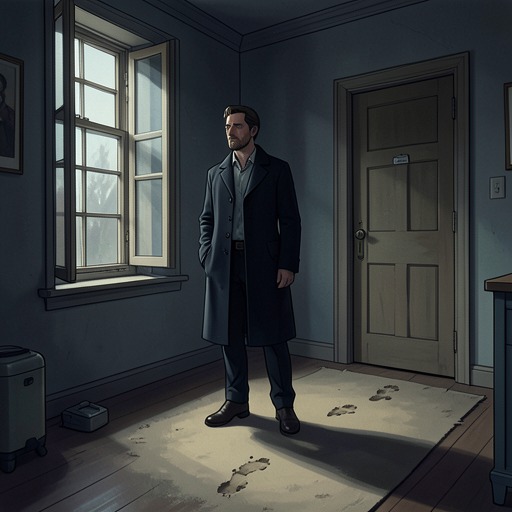
Raglan’s suspicion of Ralph rests on a concentrated set of circumstances. He reports that Ralph left shortly after nine, was seen near Fernly Park at about half past nine, and has not been seen since. Raglan also cites Ralph’s serious financial difficulties and a pair of shoes with rubber studs, which he intends to compare with the marks at the study window. These details give the theory an apparent connection between motive, opportunity, disappearance, and physical evidence, although none alone establishes that Ralph committed the murder.
Raglan makes the theory vivid by arranging the evening into a minute-by-minute reconstruction. He places Ralph passing the lodge at twenty-five past nine, then uses Geoffrey Raymond’s report of a demand for money and Ackroyd’s refusal at about half past nine as the next point in the sequence. In Raglan’s account, Ralph returns by the window, finds the drawing room empty, takes the dagger from the silver table, enters the study, kills Ackroyd, and leaves again through the window. Raglan further supposes that Ralph then avoids returning to the inn and goes to the station. The sequence is persuasive in its precision, but it is still an invented explanation of the clues, not an eyewitness account.
Raglan’s method is explicitly chronological. He begins with Flora’s statement that she last saw Ackroyd alive at a quarter to ten, then invokes Sheppard’s estimate that Ackroyd had been dead at least half an hour by half past ten. From those times he constructs a narrow opportunity for the killing. The method lends his account the appearance of rigor, yet the later inquiry shows why a timeline must be distinguished from proof: a coherent order of events can still depend on mistaken assumptions about who was present and what the traces mean.
Encounters with Poirot
Raglan’s confidence meets a different investigative style when Poirot joins the police inquiry. Raglan treats his reconstruction as self-evident; Poirot asks what follows from each clue and keeps alternative explanations open. When the footprints are under discussion, Poirot’s questions and deductions complicate the simple attribution to Ralph. The eventual reasoning considers whether the marks could genuinely be Ralph’s, whether someone else with similar studded footwear could have made them, and how the murder’s mechanical arrangements bear on the identity of the culprit.
Poirot also tests people rather than relying on the first interpretation of their statements. He plans an experiment at Fernly to determine whether voices from the lobby could be heard outside on the terrace, recruiting Flora’s assistance and proposing a reconstruction involving Parker. Later, after the joint funeral of Mrs. Ferrars and Ackroyd, Poirot tells Sheppard that they must question Parker and put him under enough pressure for the truth to emerge. These episodes belong to Poirot’s investigation, not Raglan’s, but they sharpen the contrast between Raglan’s early confidence and a process that treats testimony and physical circumstances as hypotheses to be checked.
Revisions and Investigation
Raglan remains involved as the case broadens. He travels with Poirot and Sheppard to Liverpool to pursue Charles Kent, whom he regards as a possible lead in the blackmail aspect of the case. Raglan describes Kent as a rough customer and a drug user, and reasons that such a suspect might have both motive and a connection to the crime. At this point he is still trying to reconcile Kent with Ralph’s disappearance, calling the case a muddle. His remarks show that the investigation has not resolved into a single stable theory, despite the certainty with which he earlier presented Ralph’s supposed movements.
The inquiry supplies a specific check on Kent’s whereabouts. Raglan later tells Sheppard that Kent’s alibi is sound: Sally Jones, the barmaid at the Dog and Whistle, recognizes Kent from a group of photographs and places him there at a quarter to ten, more than a mile from Fernly Park. She also recalls that he had a large amount of money, which connects him to the forty pounds Flora had taken. The evidence does not make Raglan’s earlier interest in Kent irrational; it gives the police a way to test it and then distinguish an apparent financial clue from proof of murder.
The final investigation further exposes how easily a visible clue can be assigned to the wrong person. Poirot explains that the footprints admit more than one hypothesis and emphasizes that the household’s shoes were soled with crepe rubber, while Kent’s boots were badly worn. He also draws attention to the murder weapon’s removal from the silver table before Flora examined it, the killer’s knowledge of Ackroyd’s Dictaphone, the required mechanical aptitude, and the opportunity to conceal the device in a black bag and to be alone in the study while Parker telephoned the police. Raglan is present when Poirot sets out this cumulative chain. The case has moved from Raglan’s broad reconstruction of Ralph’s movements to a more discriminating account of opportunity, means, and access.
Role in the Final Exposure
When Poirot gathers the household, he deliberately does not invite Raglan. He explains that he does not want to disclose everything he knows to the inspector that night, because he wants the real murderer to confess in order to save Ralph. Poirot then addresses the culprit in the room directly, warning that the truth will go to Raglan the following day. Raglan’s absence is therefore tactical rather than a dismissal of his authority: the confession is to be elicited before the police receive the complete case.
Raglan’s character is defined less by a final personal revelation than by the investigation’s changing standards of certainty. He arrives convinced that Ralph’s movements and shoes explain the crime; he pursues another suspect when the inquiry turns toward Kent; and he receives a verified alibi that rules Kent out as the killer. At the climax, Poirot’s withheld conclusions and promise to report the truth to Raglan mark the boundary between private detection and police action. Raglan serves as the public investigator against whom the novel measures the hazards of premature closure: a plausible timeline can organize suspicion, but only sustained testing of details can establish what happened.